The Modernization Imperative
Enterprise applications built over the past few decades form the backbone of most organizations. These systems process transactions, manage customer relationships, and handle critical business operations. While they've proven their reliability, the gap between legacy capabilities and modern expectations continues to widen.
The challenge isn't just technical—it's strategic. Organizations need to innovate faster, integrate with cloud ecosystems, and deliver experiences that users now expect. Traditional modernization approaches, requiring armies of developers and years of effort, simply can't keep pace.
This is where generative AI enters the picture, fundamentally changing what's achievable in application modernization.
Understanding the AI Advantage
Generative AI differs from traditional automation in a crucial way: it can understand context, recognize patterns, and produce novel outputs. Rather than following rigid rules, it can analyze complex legacy systems and generate modern equivalents that preserve business logic while embracing contemporary architectures.
This capability transforms modernization from a labor-intensive translation exercise into an intelligent transformation process.
Key Capabilities Driving Transformation
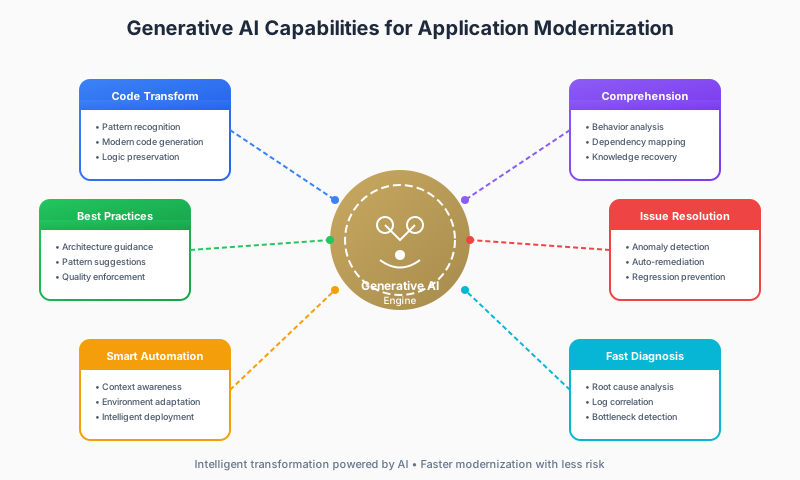
Automated Code Transformation
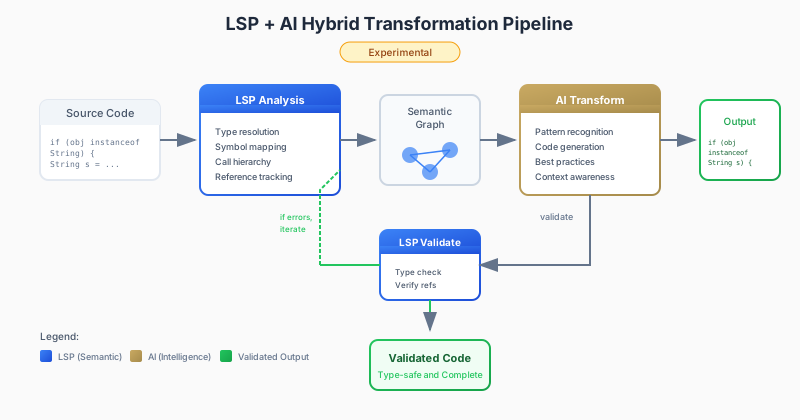
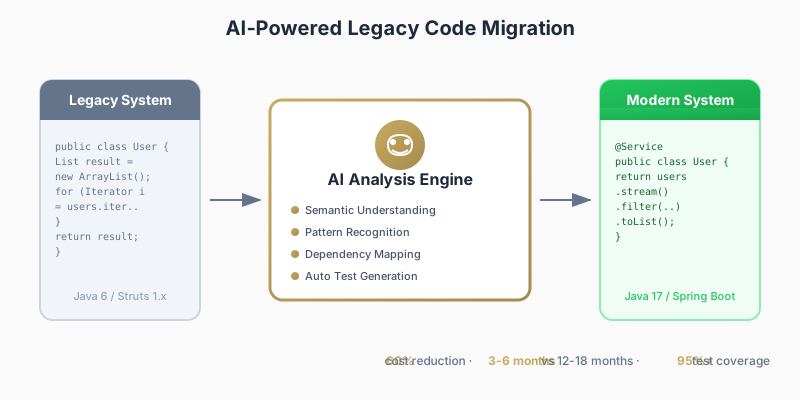
One of the most impactful applications of generative AI is its ability to transform legacy code into modern equivalents. Instead of developers manually rewriting thousands of lines, AI can analyze existing code patterns and generate updated versions.
Consider a system with hundreds of similar data access patterns. AI can recognize these patterns, understand their intent, and generate modern implementations using current frameworks and best practices—all while maintaining functional equivalence.
What this enables:
- Rapid conversion of repetitive code structures
- Consistent application of modern patterns
- Preservation of business logic during transformation
Legacy System Comprehension
Many legacy systems suffer from inadequate documentation and lost institutional knowledge. The original architects have moved on, comments are sparse, and tribal knowledge has faded.
Generative AI excels at analyzing code behavior to reconstruct understanding. By examining execution paths, data flows, and system interactions, it can build comprehensive maps of how legacy applications actually work—not just how they were supposed to work.
What this enables:
- Recovery of undocumented business rules
- Identification of hidden dependencies
- Creation of accurate system documentation
Intelligent Pattern Application
Modern software development has established patterns and practices that improve maintainability, security, and performance. However, applying these consistently across a large modernization effort requires significant expertise and discipline.
AI can serve as an always-available expert, analyzing code as it's transformed and suggesting improvements aligned with current best practices. This ensures that modernized applications don't just work—they work well.
What this enables:
- Consistent application of architectural patterns
- Proactive identification of anti-patterns
- Continuous quality improvement during transformation
Proactive Issue Resolution
Legacy systems often carry years of accumulated workarounds and quick fixes. During modernization, these can surface as unexpected behaviors or failures.
AI-powered monitoring can detect anomalies in modernized systems, trace them to their root causes, and in many cases, implement corrections automatically. This dramatically reduces the stabilization period after migration.
What this enables:
- Automatic detection of regression issues
- Rapid identification of legacy-related problems
- Reduced operational burden post-migration
Environment-Aware Automation
Modernization rarely happens in isolation. Applications must integrate with existing infrastructure, whether that's on-premises databases, cloud services, or hybrid environments.
Generative AI can understand the target environment and adapt its outputs accordingly. Whether deploying to containers, serverless platforms, or traditional servers, the generated code and configurations align with the specific context.
What this enables:
- Seamless adaptation to diverse deployment targets
- Intelligent handling of environment-specific requirements
- Reduced manual configuration and adjustment
Accelerated Problem Diagnosis
When issues arise in modernized systems—and they inevitably do—finding the root cause can be challenging. The interaction between old logic and new infrastructure creates complex debugging scenarios.
AI can analyze system behavior holistically, correlating logs, metrics, and code paths to pinpoint issues quickly. What might take developers hours of investigation can be identified in minutes.
What this enables:
- Faster mean-time-to-resolution
- Correlation of complex multi-system issues
- Proactive identification of potential problems
Emerging Capabilities
The field continues to evolve rapidly. Additional capabilities gaining traction include:
- Automatic Test Generation – Creating comprehensive test suites based on observed system behavior
- Documentation Synthesis – Producing technical documentation from code analysis
- Security Vulnerability Detection – Identifying and remediating security issues in legacy code
- Performance Optimization – Suggesting improvements based on runtime analysis
The Human Element
While generative AI dramatically accelerates modernization, human expertise remains essential. AI excels at pattern recognition and code generation, but understanding business context, making architectural trade-offs, and validating outcomes requires human judgment.
The most effective approach combines AI capabilities with experienced practitioners who can guide the process, validate outputs, and handle the nuanced decisions that determine project success.
Looking Forward
Generative AI represents a fundamental shift in how organizations can approach legacy modernization. What once required years of effort and significant risk can now be accomplished faster, with greater confidence, and at lower cost.
The technology continues to mature, with each advancement expanding what's possible. Organizations that embrace these capabilities position themselves to modernize more effectively while competitors remain mired in manual approaches.
Ready to explore how AI-powered modernization can transform your legacy systems? Request a demo to see SiliconAgent Transform in action.