The Challenge with AI-Only Transformations
AI-powered code generation has made remarkable strides. Large language models can understand code context, recognize patterns, and generate functional code. However, when it comes to large-scale code transformations—like migrating a million-line Java 8 codebase to Java 17—AI alone faces some challenges:
- Hallucinations: AI might reference methods or classes that don't exist
- Type mismatches: Generated code may have subtle type errors
- Broken references: Renamed symbols might not be updated everywhere
- Missing context: AI may not see the full dependency graph
These issues are manageable in small codebases where developers can manually review every change. But at enterprise scale, we need something more robust.
Enter Language Server Protocol
Language Server Protocol (LSP) was originally designed to provide IDE features like autocomplete, go-to-definition, and find-references across different editors. But its capabilities go far beyond syntax highlighting.
LSP provides compiler-level understanding of code:
What LSP Knows
- Symbol Resolution: Where is every function, class, and variable defined?
- Type Information: What type does this expression evaluate to?
- Call Hierarchies: Which functions call which other functions?
- Reference Tracking: Where is this symbol used throughout the codebase?
- Diagnostics: What errors exist in this code?
This is the same information your IDE uses to show red squiggles under errors—except we can access it programmatically.
The Hybrid Approach
We're exploring how these two technologies might complement each other:
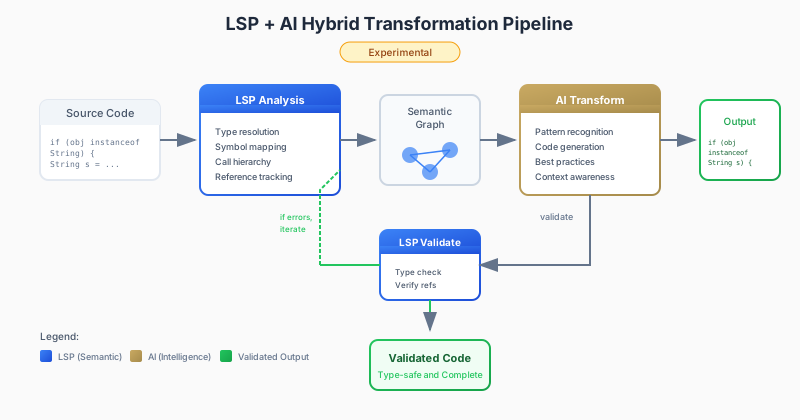
Phase 1: LSP Analysis
Before any transformation begins, LSP analyzes the entire codebase to build a semantic graph:
Semantic Graph Contains:
├── All symbol definitions and their locations
├── Type hierarchy and inheritance relationships
├── Method signatures and their parameters
├── Call graphs (who calls what)
├── Reference maps (where each symbol is used)
└── Current diagnostics (existing errors/warnings)
This gives us a complete, accurate picture of the codebase—not based on pattern matching, but on actual compiler analysis.
Phase 2: AI Planning
With the semantic graph in hand, AI can make informed decisions:
- Identify transformation candidates (e.g., all
instanceofchecks with casts) - Assess risk based on usage patterns
- Plan transformation order based on dependencies
- Generate migration strategy
Phase 3: AI Generation
AI generates the transformed code, but now with full context:
- Knows exact type constraints from LSP
- Understands which methods are overridden
- Sees full call hierarchy for impact analysis
- Can check reference counts before renaming
Phase 4: LSP Validation
After AI generates new code, LSP validates it:
- Type-check all modified code
- Verify no broken references
- Ensure method signatures match overrides
- Confirm no new errors introduced
If validation fails, the system can iterate—either adjusting the transformation or flagging for human review.
Practical Example: Pattern Matching Migration
Consider upgrading instanceof checks from Java 8 style to Java 17 pattern matching:
Before:
if (shape instanceof Circle) {
    Circle c = (Circle) shape;
    return c.radius() * c.radius() * Math.PI;
}
After:
if (shape instanceof Circle c) {
    return c.radius() * c.radius() * Math.PI;
}
How the Hybrid Approach Handles This
- LSP identifies: All
instanceofexpressions in the codebase - LSP verifies: The cast target type matches the instanceof check
- LSP confirms: The variable
cisn't already in scope - AI generates: The pattern matching equivalent
- LSP validates: The new code type-checks correctly
This catches edge cases that pure text-based transformation might miss:
- Nested
instanceofchecks with same variable names - Cases where the cast is to a subtype, not the exact type
- Situations where the variable is reassigned later
Why We're Excited (and Cautious)
This hybrid approach shows promise for several reasons:
Potential Benefits:
- More accurate transformations with fewer errors
- Automatic validation reduces manual review burden
- Better handling of edge cases
- Confidence in large-scale migrations
Current Limitations:
- LSP startup time for large codebases
- Memory requirements for semantic analysis
- Complexity of orchestrating both systems
- Still requires human oversight for architectural decisions
Current Status
This approach is currently in our research phase. We're:
- Building prototypes for specific transformation types
- Measuring accuracy improvements over AI-only approaches
- Evaluating performance characteristics at scale
- Gathering feedback from early testing
We believe the combination of LSP's semantic accuracy with AI's intelligent generation could represent an advancement in automated code transformation—but we're committed to thorough validation before making any promises.
What's Next
We'll continue sharing our findings as we learn more. If you're interested in this approach or have experience with similar techniques, we'd love to hear from you.
The goal isn't to replace developer judgment—it's to give developers tools that are accurate enough to trust at scale, while still keeping humans in the loop for the decisions that matter.
This post reflects ongoing research. The techniques described are experimental and may evolve significantly as we learn more.